
What cannot be downloaded in an age of artificial intelligence
As artificial intelligence accelerates and serious thinkers speak openly about digital immortality, an ancient question quietly returns: what is consciousness, really? Is it knowledge, awareness, identity, experience, or something more elusive—something that cannot be uploaded, measured, or replicated? This reflection begins with a moment of confusion and curiosity and unfolds into a deeper inquiry about what still matters in a world increasingly shaped by machines.
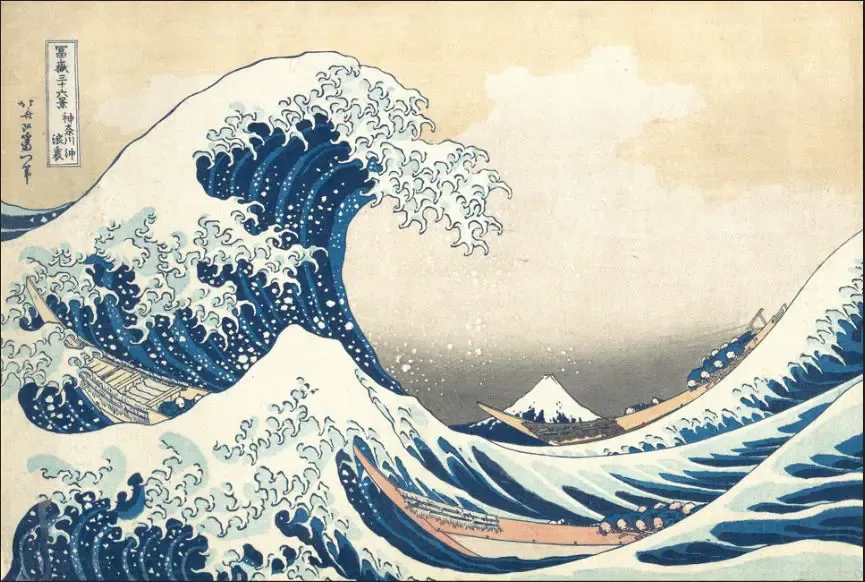
The Great Wave, 1831 Katsushika Hokusai
Some years ago, I attended a conference at Bard College where Ray Kurzweil, Google’s Chief Visionary and author of Singularity, spoke about his vision for the future of humanity. He described a time when human consciousness could be downloaded onto machines, when decay and death would be overcome, and we could live forever.
I struggled to grasp what he meant. I have always found the word consciousness elusive. I knew, of course, that I was once a baby, a toddler, a child, a teenager—and that in each of those stages I thought and perceived the world in ways now inaccessible to me. I learned this as a parent, when I understood that the vast chasm between the consciousness of the generations could only be crossed by love.
So as Kurzweil spoke, I wondered: Was he referring to information and data? To accumulated experience? To a particular way of thinking? To identity? Or to something else entirely? How could something so amorphous be downloaded? Can you download love?
In the Q&A I asked Ray Kurzweil to please define consciousness.
He spoke for half an hour.
I was not enlightened. Perhaps, at that time, he was also trying to answer that question for himself.
It is a difficult question. Philosophers, scientists, theologians, and “ordinary” people have wrestled with the concept for centuries. Major religions offer a consciousness (God) that creates and sustains the world. Indigenous peoples believe that all beings possess a spiritual essence that interacts and influences the consciousness of other life forms, and is one with the material world.
Contemporary thinkers offer other definitions. Michael Pollan suggests awareness. Yuval Noah Harari, in a recent podcast, proposed the capacity to suffer. Giulio Tononi, a neuroscientist, posits a theory of Integrated Information that aims to model consciousness mathematically. David Chalmers suggests that consciousness may be a fundamental property of the universe, like time, space, and matter.
Consciousness, like love, resists clean definition.
Why does this matter? Why should we care about an abstract concept?
We live in a time when brilliant, successful people openly predict the eventual irrelevance, or even extinction, of the human race. Against that backdrop, consciousness becomes more than a philosophical curiosity. It forces us back to a deeper question:
Who are we, really?
I do not claim any scholarly authority on this subject. What I have is lived experience, awareness of the interconnection of all things, and of other realms. I find myself leaning toward panpsychism, the idea that everything that exists participates in consciousness, even molecules and rocks.
Is the universe conscious, as panpsychism suggests? And if so, what are the implications of that understanding?
It would suggest that the universe is aware of itself, aware of the beings within it, capable of learning, and capable of relationship—not as a distant, impersonal force, but as something responsive, participatory, and alive.
This reframes our role. It suggests that we matter not through dominance or historical importance, but in a quieter way, like a single droplet of water that seems insignificant yet contributes to the depth and volume of the ocean. It suggests that what we think and feel matters more than we imagine; that we have no “private” thoughts; that our very existence is a contribution and an ongoing conversation, in which we influence the universe even as it influences us.
After dedicating decades to the practice of sound meditation, one thing has become especially clear to me: Beneath the constant activity of opinions, identities, arguments, and roles, there is a deeper stillness. Using our own voices, through wordless tones, we can build a bridge between our physical bodies and what feels like the core resonance of the universe itself.
This grounded connection brings us into contact with something that cannot be definitively named, but which feels like a universal mind—not passive, not inert, but vividly alive and conscious.
Here we are reminded of the limits of the ego. Ego may be the vehicle we drive to function and survive, but it is not our essence.
What is our essence?
Does it in fact exist? Do we own it? Can it be downloaded? Does it survive death?
Perhaps we confuse identity with essence. Identity is largely a construction; it is shaped by genetics, culture, nationality, ethnicity, circumstance, and will. It takes time and effort to construct, so much effort that we can forget that identity is clothing, clothing that covers our undefended nakedness. But clothing can be stripped away, sometimes slowly, sometimes violently, leaving us exposed.
That exposure has consequences. If we are displaced, despised, stateless, or erased by circumstance, we learn how fragile identity is. Conversely, wealth and success can lull us into believing identity is unassailable.
Even if much of life is lived on autopilot, there are aspects of us that remain fully alive, not to certainty or opinion, but to Mystery.
That is why the idea of universal consciousness matters.
What we think and feel matters, not because of egoic importance, but because we are participating in something larger than ourselves. As much as we are shaped by consciousness, we are also shaping it. There is a quiet happiness in this humility and responsibility.
This is a critical time. Awareness is imperative.
Not the distracted “awareness” shaped by outrage cycles, streaming media, or political manipulation, but a deeper, steadier awareness of our core connection to the resonance of the universe itself
That connection can be cultivated through meditative practices that restore stillness, and inner coherence in a noisy world; and they calm us and those in our circle, and illuminate a path forward.
©2026 Shulamit Elson